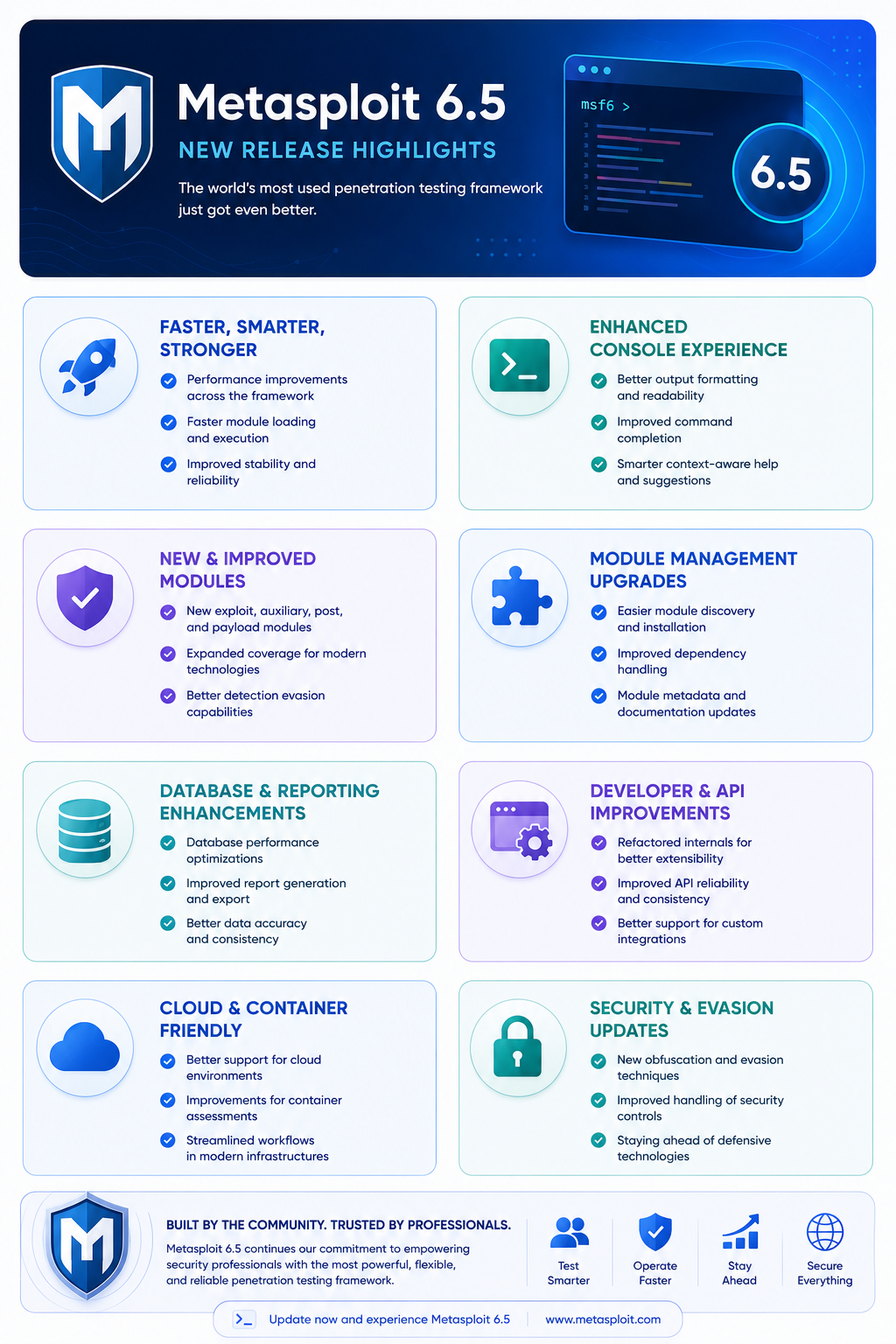

Metasploit has been around for a long time, but it continues to be one of those tools that finds its way into penetration tests, red team exercises, security research, and plenty of lab environments. Rapid7 has now released Metasploit Framework 6.5, bringing another collection of improvements to the framework.
This isn't simply a release containing more exploit modules. Metasploit 6.5 includes changes across authentication protocols, Active Directory attacks, credential handling, payloads, post-exploitation, and the underlying framework.
For anyone using Metasploit as part of an offensive security toolkit, there are several changes worth knowing about.
Kerberos Gets More Attention
One of the areas that continues to improve within Metasploit is Kerberos support.
Kerberos is obviously a major part of attacking and assessing Windows and Active Directory environments, so better support here makes Metasploit increasingly useful beyond simply launching individual exploits.
Metasploit 6.5 expands its Kerberos capabilities, including improvements around Kerberos authentication and ticket handling. This allows more modules and workflows to operate using Kerberos rather than relying entirely on usernames and passwords.
That matters when working in environments where you have already obtained Kerberos tickets or other authentication material. Instead of continually dropping back to password-based authentication, those existing credentials can become part of the wider Metasploit workflow.
For red teams, this makes it easier to move between enumeration, authentication, exploitation, and post-exploitation while staying inside the framework.
LDAP and Active Directory
LDAP is another important area of improvement.
Active Directory reconnaissance frequently starts with LDAP because it provides access to information about users, groups, computers, organizational units, policies, and many of the relationships that define an Active Directory environment.
Metasploit 6.5 continues expanding the framework's ability to interact with LDAP and Active Directory environments. Combined with the Kerberos improvements, this makes Metasploit increasingly useful for identity-focused assessments rather than treating Active Directory as something that always requires completely separate tooling.
That does not mean Metasploit suddenly replaces every dedicated Active Directory tool. It does mean more of the workflow can happen within one environment.
For an operator, that is useful because discovered credentials, sessions, hosts, and authentication material can potentially feed into other Metasploit modules rather than constantly moving information between tools.
More Active Directory Certificate Services Support
Active Directory Certificate Services, or AD CS, has become an increasingly important part of Active Directory security testing.
A poorly configured certificate infrastructure can create privilege escalation paths that ultimately allow an attacker to impersonate users, obtain authentication certificates, and potentially compromise highly privileged identities.
Metasploit 6.5 expands its support for AD CS-related attack techniques and workflows.
This is particularly useful because AD CS attacks are rarely about finding a vulnerable server in the traditional sense. The problem is often the configuration surrounding certificate templates, enrollment permissions, authentication options, and the relationships between Active Directory identities and the certificate authority.
Bringing more of that functionality into Metasploit helps connect certificate-based attacks with the rest of an Active Directory assessment.
Credential and Secrets Management
Another useful improvement is how Metasploit handles credentials and secrets.
During a real penetration test or red team engagement, you rarely end up with just a username and password. You may collect passwords, hashes, Kerberos tickets, tokens, certificates, private keys, API credentials, and other authentication material.
The challenge quickly becomes managing those credentials and understanding where they can be reused.
Metasploit 6.5 continues improving how secrets can be represented and used within the framework. That becomes particularly important as authentication moves beyond traditional passwords.
Modern environments contain many different forms of identity material. Being able to capture something during one stage of an assessment and reuse it elsewhere without manually rebuilding the authentication context makes the framework considerably more useful.
Payload Improvements
Payloads remain a major part of Metasploit, and 6.5 includes continued work around Meterpreter and the payload infrastructure.
Metasploit payloads need to operate across increasingly diverse environments while dealing with modern operating-system protections, different architectures, and changing endpoint security controls.
Improvements here are not always as visible as a brand-new exploit module, but they can have a significant impact on actual engagements. A successful exploit is only useful if the resulting payload operates reliably enough to provide the access required for the next stage of testing.
Metasploit 6.5 continues refining that part of the framework.
Post-Exploitation Continues to Expand
Getting a session is rarely the end goal of a penetration test.
Once access has been established, the next questions usually involve understanding the system, identifying credentials, discovering additional hosts, examining privilege boundaries, and determining whether the initial foothold can be expanded.
Metasploit's post-exploitation capabilities have always been an important part of that process, and version 6.5 continues adding and improving modules that operate after initial access.
This is another area where having everything connected inside the framework becomes useful. Information collected during exploitation can feed into post-exploitation, which can uncover additional credentials or systems that then become targets for other modules.
Instead of thinking about Metasploit as an exploit launcher, it makes more sense to think about it as an environment for managing an offensive security workflow.
More Than Just New Modules
New Metasploit releases always bring additional modules, but focusing only on the exploit count misses much of what makes 6.5 interesting.
The framework itself continues to evolve.
Metasploit has to support a huge collection of modules written over many years while also adapting to newer protocols, operating systems, authentication mechanisms, and development practices. Improvements to the underlying framework can therefore affect hundreds of modules rather than adding one new attack technique.
That work is particularly important as offensive security becomes increasingly identity focused.
Finding a vulnerable service still matters, but modern attacks often involve understanding authentication, credentials, permissions, certificates, directory relationships, cloud identities, and trust boundaries.
Metasploit increasingly needs to work with those concepts rather than simply sending an exploit to a listening network service.
Why Metasploit 6.5 Matters
What I find interesting about Metasploit 6.5 is the continued expansion beyond traditional vulnerability exploitation.
Kerberos, LDAP, Active Directory, AD CS, credential management, and authentication workflows all reflect how real attacks have changed. Identity is increasingly one of the primary attack surfaces, whether the environment is on-premises, cloud-based, or somewhere between the two.
That makes these improvements useful for more than simply running another exploit.
A modern red team engagement might involve obtaining credentials, authenticating with Kerberos, enumerating Active Directory through LDAP, identifying a certificate-services misconfiguration, obtaining additional authentication material, and then using that access to move further through the environment.
Having more of those capabilities available within the same framework makes the overall workflow easier to manage.
Updating Metasploit
If you already use Metasploit Framework, how you update will depend on how it was installed. Package-based installations, Kali Linux, source installations, and other deployment methods can have different update processes.
After updating, you can confirm the installed version from msfconsole:
msf6 > version
If you maintain custom modules or automation around Metasploit, I would also test those before assuming everything behaves exactly as it did previously. Framework releases can introduce changes that affect custom integrations even when the normal console experience appears unchanged.
Final Thoughts
Metasploit has been part of offensive security for decades, and it would be easy to think of it simply as the tool you launch when you already know which exploit you want to run.
The framework has become much broader than that.
Metasploit 6.5 continues that evolution by improving the pieces required to work with modern authentication, Active Directory, certificates, credentials, payloads, and post-exploitation workflows.
For penetration testers and red teams, the interesting part is not necessarily any single new module. It is how those capabilities connect together.
Modern attacks increasingly move through identity rather than simply through vulnerable network services. Kerberos tickets, certificates, directory permissions, credentials, and authentication relationships can be just as valuable as an unpatched vulnerability.
Metasploit 6.5 continues moving the framework in that direction, while keeping the exploitation and post-exploitation capabilities that made Metasploit useful in the first place.