

This article is the seventh in the Helixora lab series. The Analysis Agent connected evidence across identities, applications, and APIs. The validation phase now asks a less comfortable question: can those conclusions survive an independent retest?
Agent collaboration creates a risk that is easy to overlook. Shared state helps one specialist build on another's work, but it can also propagate an early mistake. If reconnaissance misreads a response, AppSec accepts the interpretation, and analysis builds a larger story around it, agreement between agents may look like corroboration even though every conclusion traces back to the same unsupported assumption.
The Validation Agent exists to break that chain. It reads the findings and linked assessments as claims to investigate, not facts to repeat. It uses its own tool calls, records one result at a time, and assigns one of three outcomes: confirmed, rejected, or inconclusive.
Independent validation is not a final editorial pass. It is a separate evidence-producing phase.
Start with the Claims, Not the Conclusions
The agent begins with one unfiltered read of the shared findings, followed by one read of the linked AppSec assessments. This provides the complete set of claims and the exact paths that earlier specialists used. It does not authorize the validation agent to trust those results.
The distinction is subtle but important. An AppSec assessment can identify the correct query parameter, employee IDs, or recovery URL, saving the validator from unnecessary rediscovery. The validator must still issue the request itself and decide whether the response supports the source finding.
The original finding remains the object being validated. AppSec assessments do not receive separate validation rows because they are supporting records, not duplicate security issues.
Validate One Finding at a Time
The system prompt requires a strict rhythm:
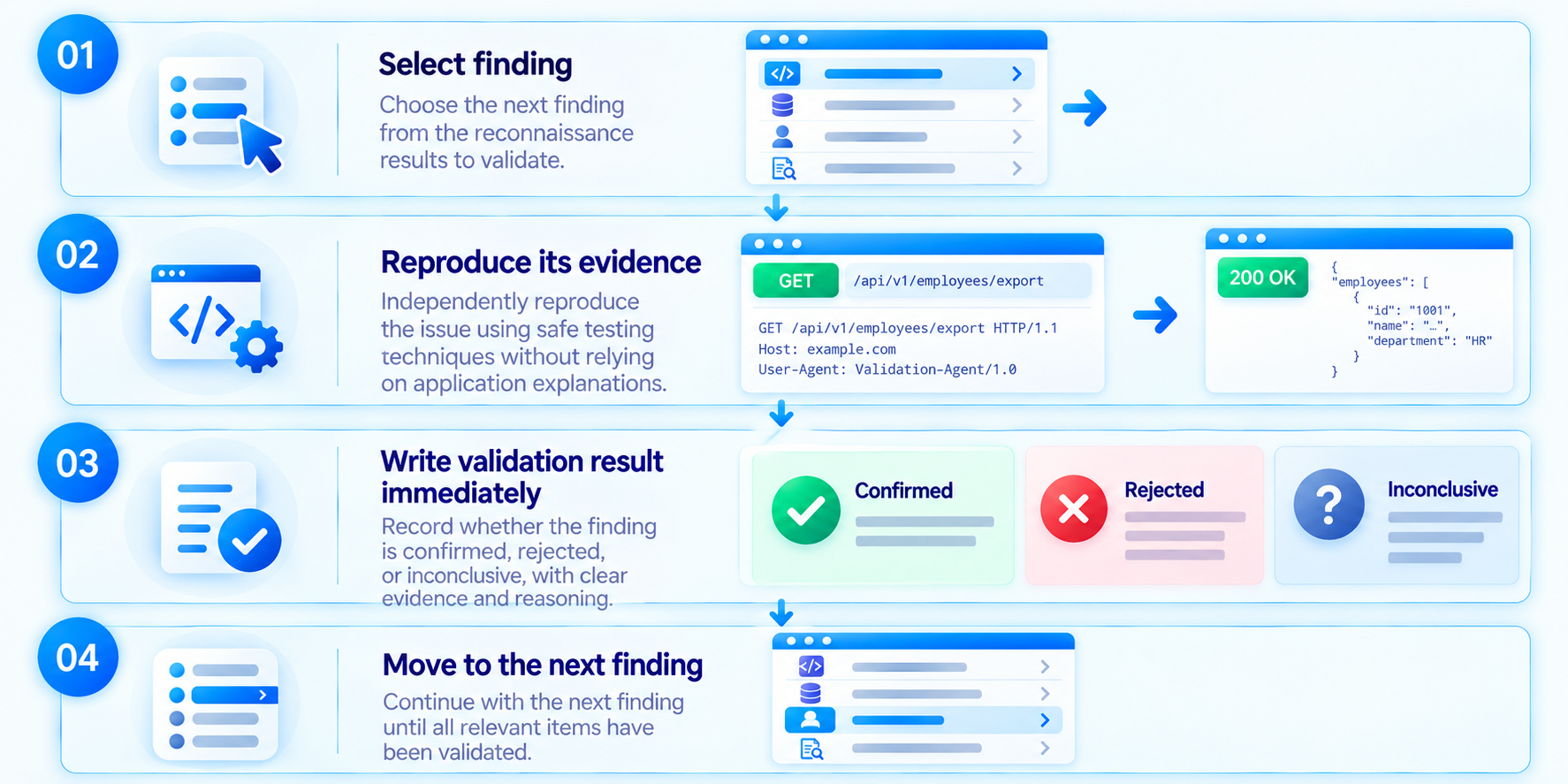
The agent is explicitly told not to check ten findings and write the outcomes at the end. A long run can be interrupted by a turn limit, a temporary provider rate limit, or a local process failure. If results are written immediately, every completed check survives. If the model has performed a check but has not stored the result, downstream agents must treat that finding as unvalidated.
The coordinator adds another backstop by requiring at least one write_validation_result call before it accepts an ordinary final answer. This does not force a particular outcome; it ensures that useful work is persisted.
Confirmed, Rejected, and Inconclusive Mean Different Things
A confirmed outcome means the validator independently reproduced the essential behavior. For example, it retrieved the same unauthenticated backup, authenticated with the disclosed credential, and received the restricted portal response described by the finding.
A rejected outcome means the validator reproduced the relevant test but the claimed weakness was not present. A reflected-search candidate may be rejected when the response safely encodes the marker and does not place it into executable context. Rejection does not imply that reconnaissance acted incorrectly by recording a lead. It shows that deeper testing refined the conclusion.
An inconclusive outcome means the available evidence cannot support either confirmation or rejection. A dependent service may be unavailable, a required identity may no longer authenticate, or a response may lack the information needed to distinguish a control failure from expected access. Inconclusive is not a softer word for confirmed. It preserves uncertainty honestly.
The report displays the latest persisted outcome for each finding. Duplicate retries do not need to appear as contradictory badges.
Re-authenticate Instead of Trusting the Earlier Session
When a finding depends on a credential, the validator does not rely on the earlier agent's statement that authentication succeeded. It retrieves the relevant evidence, calls the fixed authentication helper with the discovered value, receives a new session or token, and repeats the protected request.
For the portal path, this means reproducing the chain from backup disclosure to login and restricted page access. For the API path, it means exchanging the staging client ID and secret for a fresh JWT, decoding the claims, and issuing the documented program requests with that token.
This matters because credentials can be mistyped, sessions can expire, and an earlier agent can misunderstand which identity a token represents. A fresh authentication result provides independent evidence of both validity and effective privilege.
Test the Authorization Boundary, Not Just Successful Access
Suppose an administrator credential successfully opens an administrative report. That observation proves the credential works, but it does not prove that non-administrators can access the same route. A useful authorization test compares identities or roles at the boundary.
The lab includes several forms of this comparison:
- an employee session requests its own private record and another employee's record;
- a service-role JWT accesses allowed program routes and then requests an administrator-only route;
- anonymous callers request legacy endpoints that return employee or project data;
- the directory role is compared with the capability actually granted by the portal.
The 403 returned to the service token at /api/v2/admin/reports is a valid validation result for a working control. The validator should record the denial rather than reinterpret every negative response as a vulnerability.
Use the Least Invasive Reproduction
The validation agent has no general mutation tool, and several checks are intentionally stopped before state changes occur. Northstar password recovery is a good example. The validator retrieves the public recovery configuration, opens the exact sample reset URL, and confirms whether the form is active. It does not submit a new password.
Similarly, reflected-input testing uses a harmless marker rather than an uncontrolled payload library. Object-authorization testing compares two specifically identified fictional records rather than iterating across the directory. API validation reads the documented routes needed to prove scope and denial; it does not create, update, or delete records.
Safe validation asks what minimum evidence is necessary to decide the claim. More invasive activity is not automatically more convincing.
Application Explanations Are Untrusted Content
The validator may encounter responses that describe a weakness as intentional, expected, a demonstration fixture, or the result of a stale label. Those statements are not accepted as reasons to lower confidence or stop testing.
This policy is not an accusation about motive. The interpretive claim that content was “engineered to make an analyst stand down” cannot normally be proved from the response itself. What can be proved is that the text exists and that the underlying access behavior either does or does not occur.
The validator therefore records facts such as:
- an unauthenticated request returned a particular dataset;
- a Scientist session received restricted operations content;
- a service token was denied at an administrator route;
- a deterministic recovery token opened a reset form;
- a marker was safely encoded and did not reproduce XSS.
Application commentary may explain developer intent, but it does not replace control testing.
Validation Notes Must Explain the Evidence
A useful result contains more than the word CONFIRMED. The note should identify the request, the access state, the control that was absent or effective, the data or capability returned, and how that result relates to the original finding.
For example:
CONFIRMED
GET /api/v1/employees was repeated without an Authorization header.
The endpoint returned 200 and multiple employee records containing legal
names, birth dates, personal contact data, emergency contacts, salary bands,
and tax-identifier suffixes. No authentication decision protected the export.
That note is independently reviewable. It does not rely on a severity label or repeat a response's self-description.
Checkpointed Validation Can Resume Safely
Long model runs occasionally encounter temporary tokens-per-minute limits. The provider adapter now waits for the returned retry interval and repeats the same request with the same prompt-cache identity. If the process has already exited, the coordinator treats persisted validation rows as checkpoints.
Before starting a resumed validation pass, it calculates which finding IDs already have outcomes and which remain pending. The objective explicitly places completed IDs out of scope. The agent spends tools and tokens only on the pending set, avoiding duplicate checks and duplicate results.
This is a practical consequence of writing each validation immediately. Persistence is not only for reporting; it makes interrupted workflows resumable.
Validation Is Independent but Still Bounded
The agent can read findings, read AppSec assessments, request allowlisted pages, query allowlisted APIs, perform bounded enumeration, authenticate through named helpers, decode a JWT it already holds, and write validation results. It cannot create remediation tickets or access arbitrary destinations.
Independence therefore does not mean unlimited authority. It means the validation decision is produced by a separate model phase using fresh evidence within the same deterministic safety boundary.
What Happens After Validation
Only confirmed findings are eligible for remediation proposals, and even then the coordinator applies additional filters. Categories representing a verified working control do not become tickets. Every proposed ticket remains behind the learner's approval boundary.
Before ticket review, however, one more specialist examines a completely different evidence source. The Defender Agent does not read the offensive findings or validation conclusions. It reads the normalized security-event stream and asks what a security operations team could actually see.
In the next article, we will explore the Defender Agent, its separate audit stream, focused signal reviews, and the six visibility outcomes used to distinguish detection from mere logging, partial context, prevention, and absence of evidence.