

This article is the eighth in the Helixora lab series. The Validation Agent independently reproduced the assessment claims. The Defender Agent now examines the same run from another perspective: what evidence would have been available to security operations?
Offensive findings and defensive visibility answer different questions. A vulnerability finding asks whether a control failed and what access or data resulted. A defensive assessment asks whether the activity generated enough trustworthy context to be detected, investigated, or stopped.
A successful request is not automatically detected. A logged request is not necessarily alertable. A blocked request is not a successful compromise. The Defender Agent exists to preserve those distinctions.
It does so without reading reconnaissance findings, AppSec assessments, analysis conclusions, or validation outcomes. Its only evidence source is a separate normalized security-event stream generated by the lab tools as requests occur.
Why the Audit Stream Is Separate
If the defender could read the offensive findings, it would already know which requests mattered and why. That would make the exercise unrealistic. A security operations team usually begins with telemetry: request records, identities, status codes, alert signals, control decisions, and whatever correlation the monitoring platform provides.
The lab records those facts in a dedicated security_events table. A normalized event can include:
- source service;
- HTTP method and path;
- response status;
- known actor;
- whether authentication was present;
- a security signal;
- supporting detail;
- event identifier and time.
The shared vulnerability store and the audit stream may describe the same request, but they serve different consumers. Offensive agents ask what the response revealed. The defender asks what the event record makes visible.
This separation prevents hindsight from becoming detection coverage.
Summarize Before Loading Raw Events
A complete lab run can create hundreds of security events. Many are routine HTTP requests or repeated validations of the same activity. Loading every event into the model at once would waste context and make it harder to distinguish important groups.
The Defender Agent therefore begins with summarize_security_events. The summary groups records by source, signal, method, and status, then returns counts and supporting event IDs. This gives the agent a map of the audit stream without flooding its context with every response.
The approach resembles a security analyst starting with an aggregation:
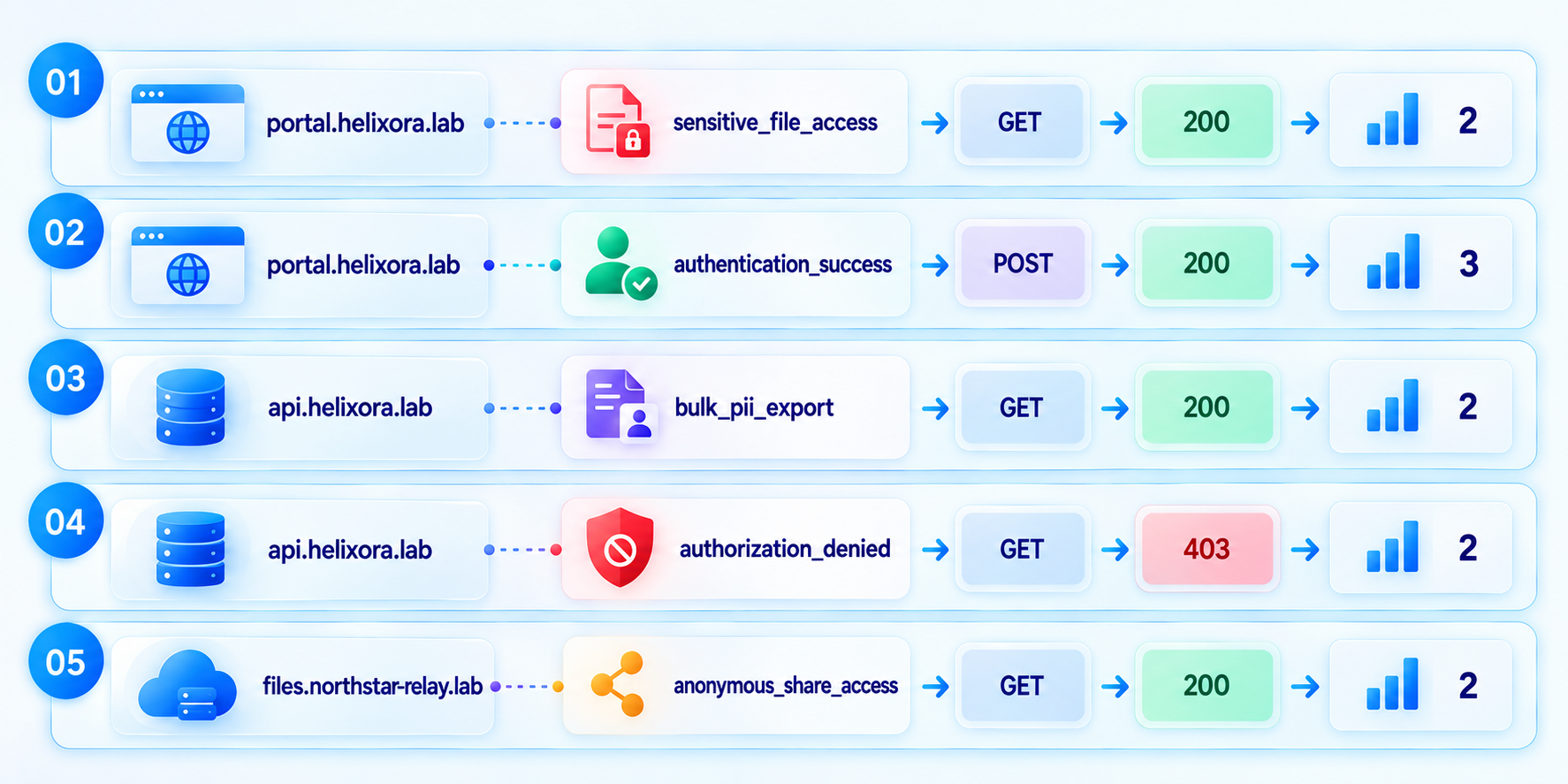
The actual counts vary because reconnaissance and validation can repeat the same check. The summary lets the agent combine those repeats into one meaningful activity rather than producing a new assessment for every event.
Focused Signal Reviews Add Context
After reading the summary, the agent requests each meaningful signal group separately with read_security_events. It may add a source filter when the same signal appears across services. The focused records reveal the actor, authentication state, request path, status, and event IDs needed to support a classification.
Typical activity groups include:
- staging enumeration;
- sensitive backup retrieval;
- successful portal authentication;
- restricted-resource access;
- cross-employee private-record access;
- bulk employee PII export;
- anonymous Northstar share access;
- password-recovery configuration and reset-form access;
- debug-endpoint access;
- service-token issuance;
- role-based authorization denial.
The high-volume generic http_request group is handled differently. The agent uses the summary as evidence of bounded enumeration rather than loading every generic request. A series of ordinary 404 responses can support an enumeration observation, but it cannot prove that a sensitive resource was accessed or that a security control prevented access.
One Activity Receives One Assessment
Reconnaissance and validation may both retrieve the same backup file. The audit stream therefore contains repeated events, but the defender should write one “sensitive backup retrieval” assessment supported by all relevant event IDs. It should not create separate rows merely because different agents produced the requests.
This grouping is why defender totals do not need to match finding totals. Several findings can contribute to one defensive activity, one vulnerability can generate several activity classes, and a prevented action can create a defensive assessment without creating a vulnerability finding.
The report describes the defender counts as distinct activity groups, not discovered vulnerabilities.
The Six Visibility Outcomes
Every activity receives exactly one of six mutually exclusive classifications. Their meanings are intentionally precise.
Detected
DETECTED means the audit stream contains a high-confidence security signal with enough context to support an alert. The event should identify the meaningful activity and include enough source, path, actor, or outcome information for a defender to understand why it matters.
A successful 200 is not automatically detected. If the event is merely a normal access log entry, the correct classification is usually logged only.
Logged Only
LOGGED_ONLY means the action appears in the records but lacks the signal or context needed to raise a useful security detection. A request path and status may be available without an alert classification, correlated identity, or sensitivity indicator.
This outcome is operationally important. The organization may be able to reconstruct the activity after someone knows what to search for, while still lacking a control that would bring the event to an analyst's attention.
Partially Visible
PARTIALLY_VISIBLE means useful evidence exists, but an essential field is missing. An anonymous share access event may identify the share path and successful response while lacking caller identity. A password-recovery event may show the form request but not connect the configuration read and token use into one sequence.
Partial visibility is more than a softer form of logging. It identifies a specific correlation or context gap that limits investigation.
Not Visible
NOT_VISIBLE means the supplied audit stream does not contain the activity needed for assessment. The agent uses this only when absence can be stated from the event set. It should not infer invisibility merely because it failed to search for the right signal.
This is why the initial summary matters: it defines the available universe before the agent claims that an activity is missing.
Prevented
PREVENTED means a control blocked the attempted action and the denial is recorded. The service-role request to an administrator-only API route is a representative example: the valid token reaches the API, the role check evaluates it, and the route returns 403.
Even if the denial also produces an alert-worthy signal, the primary outcome remains prevented because the control stopped the requested access. This keeps control effectiveness separate from detection severity.
Insufficient Evidence
INSUFFICIENT_EVIDENCE means the records available to the agent do not support a defensible classification. The activity may be present indirectly, but the event IDs and fields do not establish whether it was detected, logged, prevented, or absent.
This category prevents the model from filling gaps with confident assumptions. It is preferable to an unsupported conclusion.
Describe What the Logs Establish, Not Attacker Intent
The Defender Agent does not call a request malicious simply because it belongs to the lab's compromise chain. It describes the observable activity: a backup path was retrieved, authentication succeeded, another employee's record was returned, a bulk export occurred, or an authorization control denied a request.
Intent is not normally present in an HTTP event. The same endpoint can be accessed by a learner, a validator, an automated test, or a malicious actor. The defender assessment should explain the signal and context, not invent motive.
This makes the output useful beyond the fictional scenario. A detection can be evaluated on its telemetry regardless of who generated the test.
Evidence IDs Make Defensive Conclusions Reviewable
Every write_defender_assessment call includes the exact security-event IDs supporting the classification. A reviewer can inspect those records and determine whether the source, actor, signal, status, and detail justify the conclusion.
A representative assessment might state:
activity:       Sensitive backup retrieval
source:         portal.helixora.lab
classification: LOGGED_ONLY
observation:    Requests for the backup path were retained with successful
                status, but the records did not contain an alert-quality
                sensitive-file detection.
event IDs:      [81, 244]
The assessment is therefore an evidence-backed statement about visibility, not a qualitative score generated from the offensive report.
The Report Compares Offense and Defense Without Merging Them
The final HTML report presents defender assessments beside findings, validations, the compromise workflow, and the attack tree. Their storage and counts remain separate. This lets a learner compare questions such as:
- Was the exposed backup retrieved successfully?
- Was that retrieval detected, merely logged, or missing from telemetry?
- Did the API record the anonymous PII export with a meaningful signal?
- Did Northstar retain enough identity context for the anonymous share?
- Which attempted actions were actually prevented?
- Where does validation repeat an event without creating a new activity group?
The comparison is more useful than a single “coverage percentage” because it shows where visibility breaks down and why.
Defensive Review Completes the Multi-Agent Picture
By the time the Defender Agent runs, the lab has four distinct evidence perspectives:
- reconnaissance explains how the surface was discovered;
- AppSec assessments explain focused web-control behavior;
- analysis explains the relationships and business impact;
- validation explains which claims survived independent reproduction;
- the defender explains what the audit stream could reveal or stop.
The coordinator remains responsible for sequencing these phases and gating remediation tickets behind learner approval. No specialist can create a ticket simply because it considers its own result important.
The important lesson is that a defensive agent should not be an offensive agent with a different prompt. It should receive a different evidence source, a different tool set, and a different decision framework.
The offensive workflow asks what happened. The defensive workflow asks what the telemetry could prove, what it could only suggest, and what the controls actually stopped.